DIΔFORIK

Rule it
out.

In medicine there’s a standard of care: what a competent doctor must do before deciding. The repair industry has never had one. Diaforik is the standard of care for diagnosis: written down, taught, held on every job, and measured. One method, six trades. The method is published.

Start here
What Diaforik is

Written down. Taught. Held. Measured.

What’s live

One standard. Six trades.

DIΔFORIKSERVICE FLOOR · SIX TRADESTARGET1%COMEBACK RATE
LIVE1
AUTOMOTIVE & LIGHT DIESELShops · Technicians · Schools
TESTING AND DEVELOPMENT5
HARLEY-DAVIDSON
POWERSPORTS
MARINE
RV
HEAVY EQUIPMENT & FLEET

Automotive is live. The rest are built on the same standard and in testing and development: same app, same audit, same proof.

See it work

The real app, on a real case.

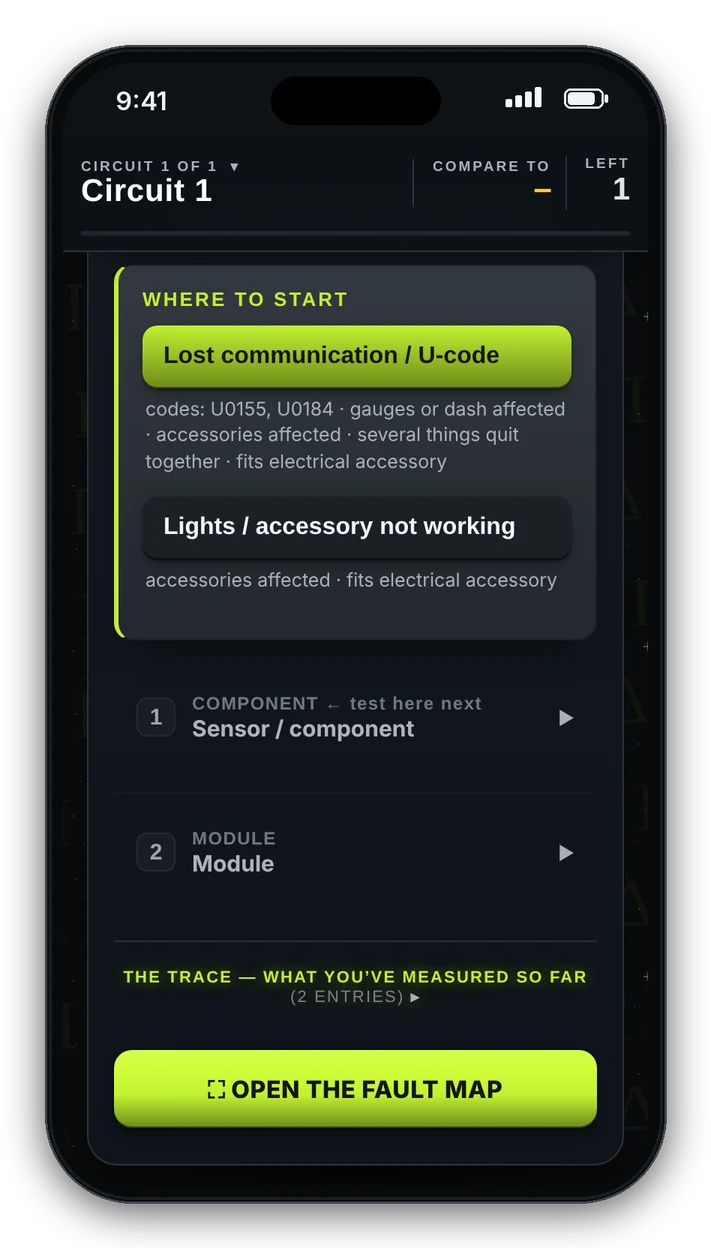
The Where to start card in the Diaforik app, suggesting Lost communication first, with its reasons.
Where to start.What quit, how much quit at once, and the codes point to the chain. The reasons are on the screen.
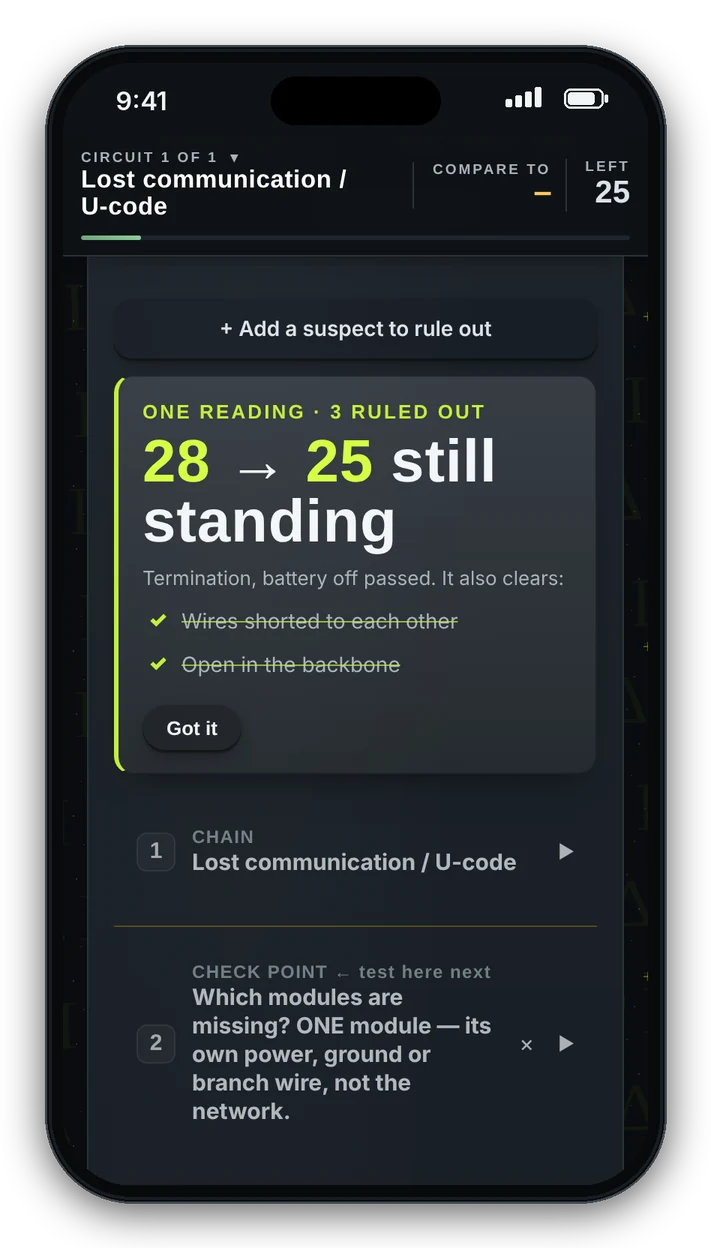
The Diaforik app showing One reading, 3 ruled out, 28 to 25 still standing.
One reading rules out three.Termination reads 60 ohms. Two more suspects drop with it: 28 still standing becomes 25.
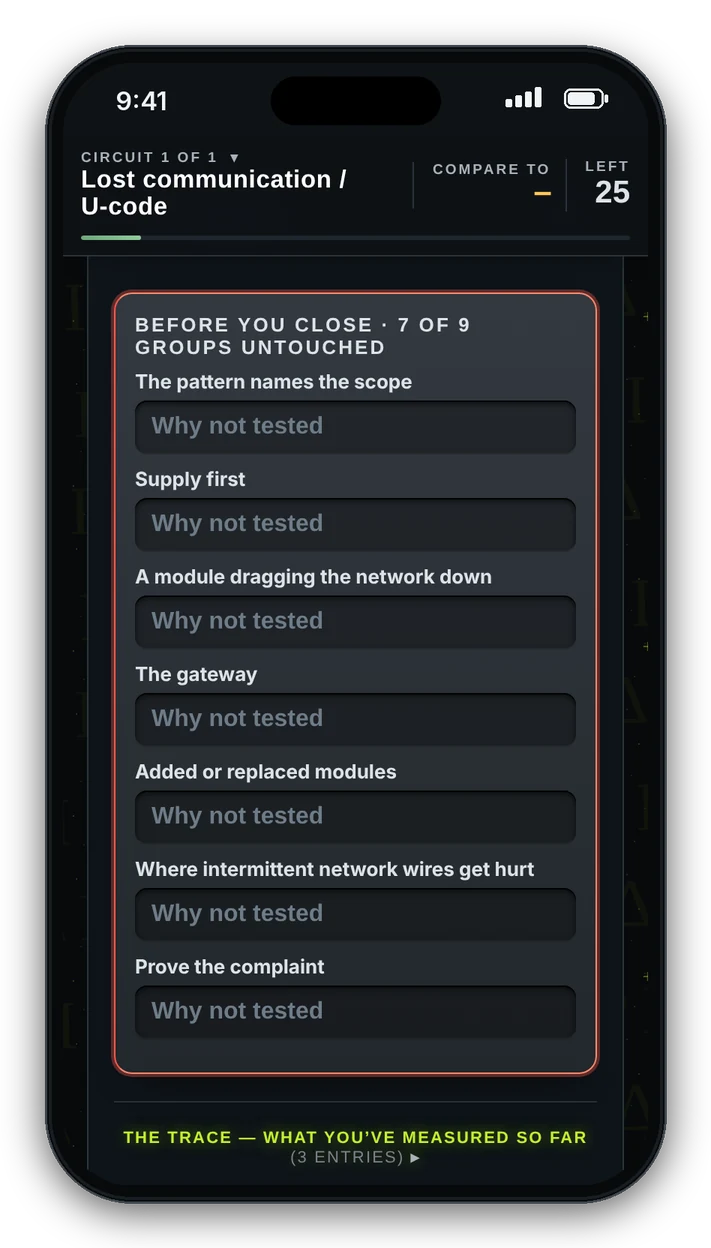
The Diaforik app stopping a close: Before you close, 6 of 9 groups untouched, each asking why it was not tested.
It won’t close on a skipped group.Every group is tested, or there’s a reason written down. Then the case closes.

A 2012 Ram whose dash drops out. Screens from the app, as a tech sees them.

Every tool and software company sells you their product. Diaforik sells you a shop that stops guessing.

This started in the back of an ambulance, not a service bay. You can’t swap in a new heart to see if it helps. You rule things out, in order, with what you can measure, until one thing is left standing.

The same is true of a truck, a boat, a camper, a bike or a loader.

No AI. Not in the app. Not in the audit.Suspect lists come from service information and physics. Audits are read by hand.

The same case has to give the same answer twice.

A fixed chain does. Give it the same complaint and the same readings tomorrow and it says the same thing, and a person can read exactly why. A model can say something different the second time, and nobody can say why. You can’t build a standard on that.

Don’t take our word for it. Open your favorite chatbot (ChatGPT, Claude, Gemini, Grok) and describe a soft brake pedal after a caliper job. Then open a new chat and ask the same thing again. Watch the answer move: the parts it names, the order it puts them in, how sure it sounds. Now imagine that on the record with your name under it.
Why there’s no AI in Diaforik: all five reasons →
What a guess costs

The bigger ticket lost the customer.

Two invoices for the same 2003 Ford Ranger. The first shop: $1,474.53 over four days, still not fixed. My Mobile Mechanic: $120, one visit, fixed and proven.
A 2003 Ranger’s pedal went soft after the shop’s own caliper job. Four days of parts came to $1,474.53, on the customer’s bill, and it still wasn’t fixed: the calipers were on the wrong sides, bleeders pointing down. Back when I ran a mobile shop, I came out once and replaced nothing: $120. That $1,474 looks like more revenue. What you don’t see is what it cost: she never went back, and every dollar she spent on that truck for the next two years went to me, not them.
$185,376ONE SAMPLE SHOP · ONE YEAR

That’s what comebacks cost a sample shop in a year: labor and parts it never billed, and customers it never saw again. It isn’t in its books anywhere. Twelve months of your repair orders already know your number.

Find your shop’s numberHow we count a comeback →
Tell me about your shop

Or skip the call. Send me your shop, and I’ll call you.

What you want
Goes to Sam. No list, no newsletter. Privacy
Published

The rules are public. The tool is the product.

Every closed case is a practical exam: a real vehicle, every reading against spec, what was ruled out, and proof it was fixed.

All free to use with attribution. Each carries a version and a date.

Call SamText